Half the Spiral
A mathematical journey from counting to the quantum
Before the climb
I wanted to begin where a child begins: with counting, adding, subtracting, and the first shape. Then I wanted to follow the mathematics far enough to reach differential equations and quantum physics. The method was to read the people who carried each step in their own words, work through what their mathematics does, and hold it beside the Spiral.
Partway up the ladder, I put the encounter this way:
I believe that math is half the spiral, and yet you cant expand unless that second spiral persists in the flow of the actual with you
— My testimony at the calculus rung. [Q28]
That is this essay's thesis. Number becomes length, length turns, and change is measured while it passes. The count and the turn keep meeting: in the diagonal, the spiral, the beat, and the exchange of energy. The models below let a reader follow those meetings. Beside them stand the historical witnesses and my own readings, with their kinships and their tensions kept visible. At the quantum end, the squared lengths of amplitudes return us to the triangle.
The ladder has nine rungs. They are a teaching order, and the tilt-and-salt interlude has no rung number. The mathematical arguments establish their stated relations; the Spiral correspondences are readings of those relations. The first-person passages speak from my recorded testimony. The explanatory models give that testimony something concrete to meet.
Rung 1 — What counts as one?
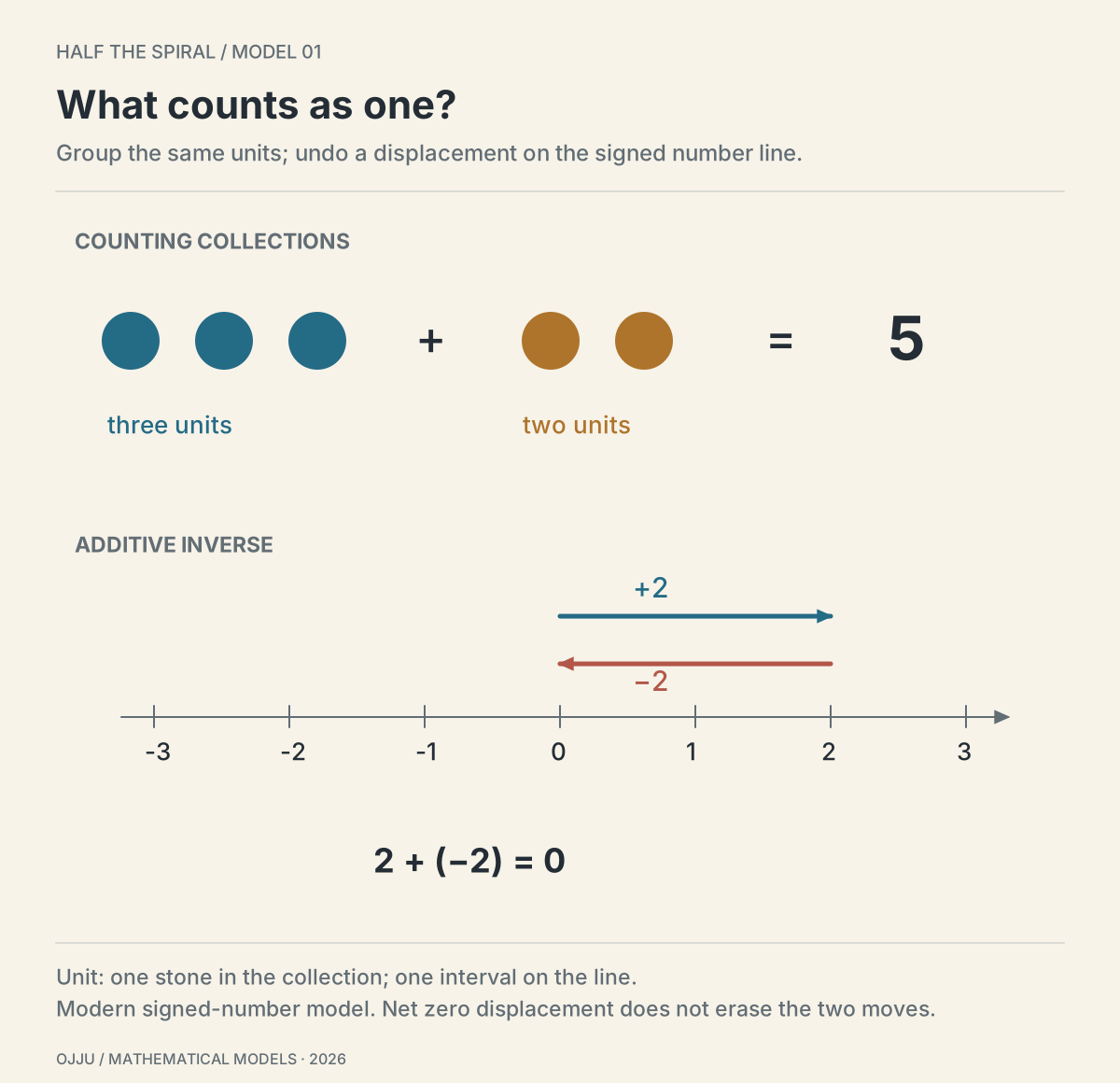
Before addition, a choice has already been made: what counts as a unit? Three stones are three stones only when each is counted once, and each counts as one stone. Their sizes and colors can differ. Counting preserves the respect in which they are alike.
Lay down a group of three and a group of two. Count each stone once across both groups: five. Remove the second group and three remain. The same units support both operations. If units change halfway through, the numeral can conceal a changed question.
3 + 2 = 5        5 − 2 = 3
x + (−x) = 0
The signed number line extends the model. A move right can be undone by an equal move left. Negative numbers here express direction and additive inverse; the empty collection and a net displacement of zero are distinct situations represented by the same numeral. The drawing uses modern arithmetic. It does not claim that every ancient writer used signed numbers this way.
The late-antique Theologumena describes the monad as:
ἐστιν ἀρχὴ ἀριϑμοῦ, ϑέσιν μὴ ἔχουσα
— Theologumena Arithmeticae, in De Falco's Greek edition. [Q01]
An editorial rendering is: the beginning of number, having no position. This is a late compilation's philosophical account of the monad, rather than a modern definition of an integer. Its language brought an earlier difficulty of mine into focus:
There was some serious confusion on my part when i tried to distinguish The One from our number one in mystus.
— My testimony in the number movement. [Q02]
The Spiral's current record gives the distinction its exact boundary:
Naming it the One makes it no number, rank or proof.
— The One, D-31. [Q29]
Correspondence. A unit makes a count possible without being everything that the count describes. The ancient monad and the Spiral's One invite comparison at that threshold. Their names do not make them identical. The practical lesson for the climb is already demanding: know which one is being used before asking what comes after it.
Rung 2 — Unequal parts, equal powers
Euclid's theorem arrives through Proclus in Taylor's translation:
In right angled triangles, the quadrangle, which is described from the side subtending the right angle, is equal to the quadrangles which are described from the sides comprehending the right angle.
— Elements I.47, carried by Proclus. [Q03]
The square on the hypotenuse has the same area as the two squares on the legs together. For legs a and b and hypotenuse c, this becomes a² + b² = c². The equality concerns squared lengths. Unequal lengths can therefore have powers whose sum is exactly the power of the third.
The plate gives a proof by rearrangement. Four identical right triangles fit inside a square of side a + b. In the first arrangement, their hypotenuses enclose a square of side c. In the second, the same triangles leave two squares of sides a and b. The outer area and the removed triangles are unchanged, so the remaining areas are equal.
(a + b)² − 4(ab/2) = a² + b² = c²
3² + 4² = 9 + 16 = 25 = 5²
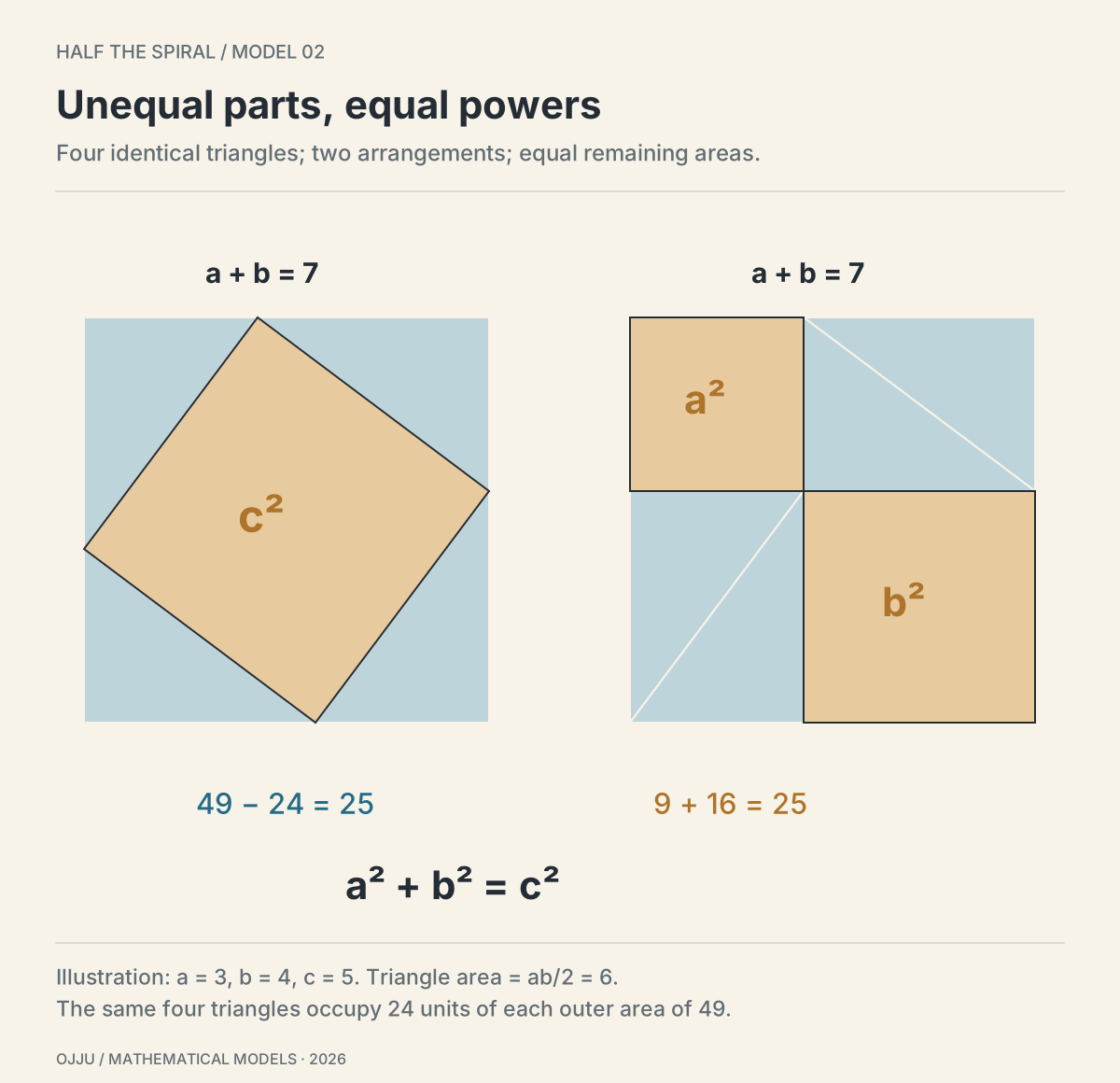
This is something a reader can enact. Cut out the triangles, turn them, and preserve their areas. The arithmetic states what the rearrangement holds. No appeal to the reputation of Pythagoras is needed to make the equality work; the historical witnesses explain how the theorem was carried and understood.
My own response to this reach across tongues was:
math is the only language that can be known beside any dialect
— My testimony after the triangle. [Q04]
Correspondence. The theorem lets unequal parts participate in one exact relation. That was the charge beneath the ladder's opening question about equal powers. A shared relation can be shown in different languages, while each witness keeps its own vocabulary. The proof gives a common act to perform, without requiring every account of that act to become the same account.
Rung 3 — The line that counting cannot finish
Draw a unit square. Its diagonal d satisfies d² = 2. It is a definite line, and its length is √2 in units of the side. Yet no ratio of integers equals that length. If d = p/q in lowest terms, then p² = 2q². Thus p is even; substituting p = 2k makes q even too, contradicting the assumption that the fraction was reduced.
The failure is specific. A finite whole-number count of a common segment cannot measure both the side and the diagonal exactly. Real-valued measurement and geometric construction remain available. Irrational does not mean undefined, imaginary, or immeasurable in every sense.
In Plato's Meno, Socrates offers another way to encounter the answer:
if you would rather not reckon, try and show me the line
— Plato, in Jowett's translation. [Q05]
A second model follows the side-and-diagonal numbers carried by Theon through Heath. Begin with side a = 1 and diagonal d = 1; repeatedly replace them by a + d and 2a + d. The ratios d/a alternate around √2. The first examples are 1, 3/2, 7/5, 17/12 and 41/29.
a′ = a + d        d′ = 2a + d
(d′)² − 2(a′)² = −(d² − 2a²)
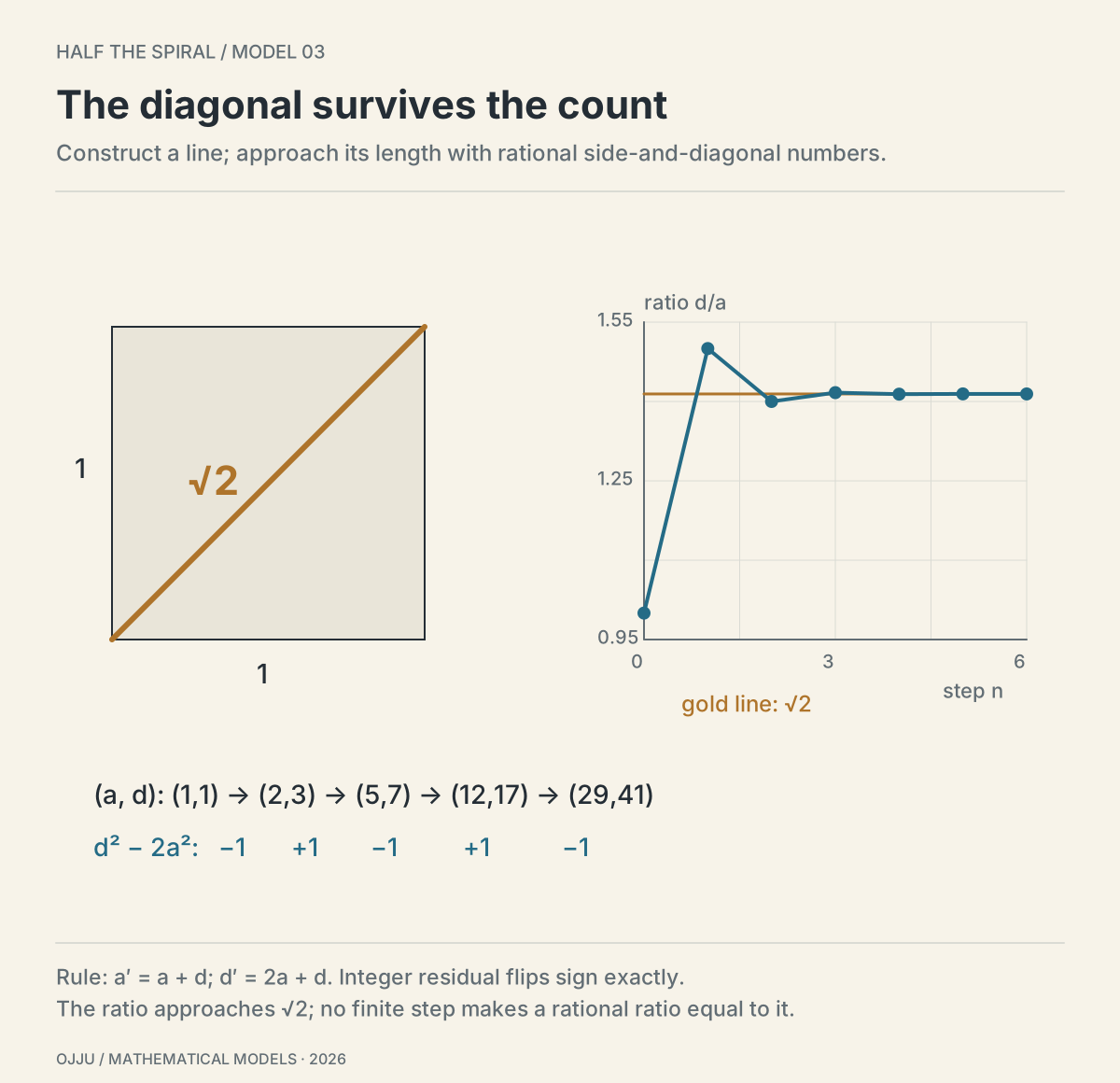
The integer residual stays at plus or minus one, flipping on every step. The ratio error shrinks because that fixed residual is being read against a growing scale. The recurrence has two eigenvalues, 1 + √2 and 1 − √2: one grows, and the other's magnitude shrinks while its sign alternates. These are exact modes of a discrete recurrence; drawing them as winding curves is an additional visualization choice.
Theon introduces the pairing this way:
The unit, being the beginning of all things, must be potentially both a side and a diameter.
— Theon of Smyrna, carried by Heath. [Q06]
When the ladder asked about counting, I brought it toward:
something like love or joy or how much a gift meant to you
— My testimony at the diagonal. [Q07]
Correspondence. A gift can have a price and a duration without those numbers exhausting its meaning. That is a kinship with the diagonal's refusal of a chosen common measure. It does not make love an irrational number. The model makes one kind of insufficiency exact, helping us speak more carefully about another.
Rung 4 — A return that changes its radius
Archimedes connects the curved to the straight:
The area of any circle is equal to a right-angled triangle in which one of the sides about the right angle is equal to the radius, and the other to the circumference, of the circle.
— Measurement of a Circle, proposition 1, in Heath's translation. [Q08]
With radius r and circumference C = 2πr, the triangle's area is rC/2 = πr². The circle has not ceased to be curved. An equality of areas lets the straight-sided figure carry its measure.
A circle returns to the same point after a complete turn. A spiral can return to the same direction at a different radius. The plate separates two ways of widening: the Archimedean spiral adds the same radial amount in equal angular intervals; the logarithmic spiral multiplies the radius by the same factor in equal angular intervals.
Circle: r = R
Archimedean spiral: r = r₀ + kθ
Logarithmic spiral: r = r₀ e^(bθ)
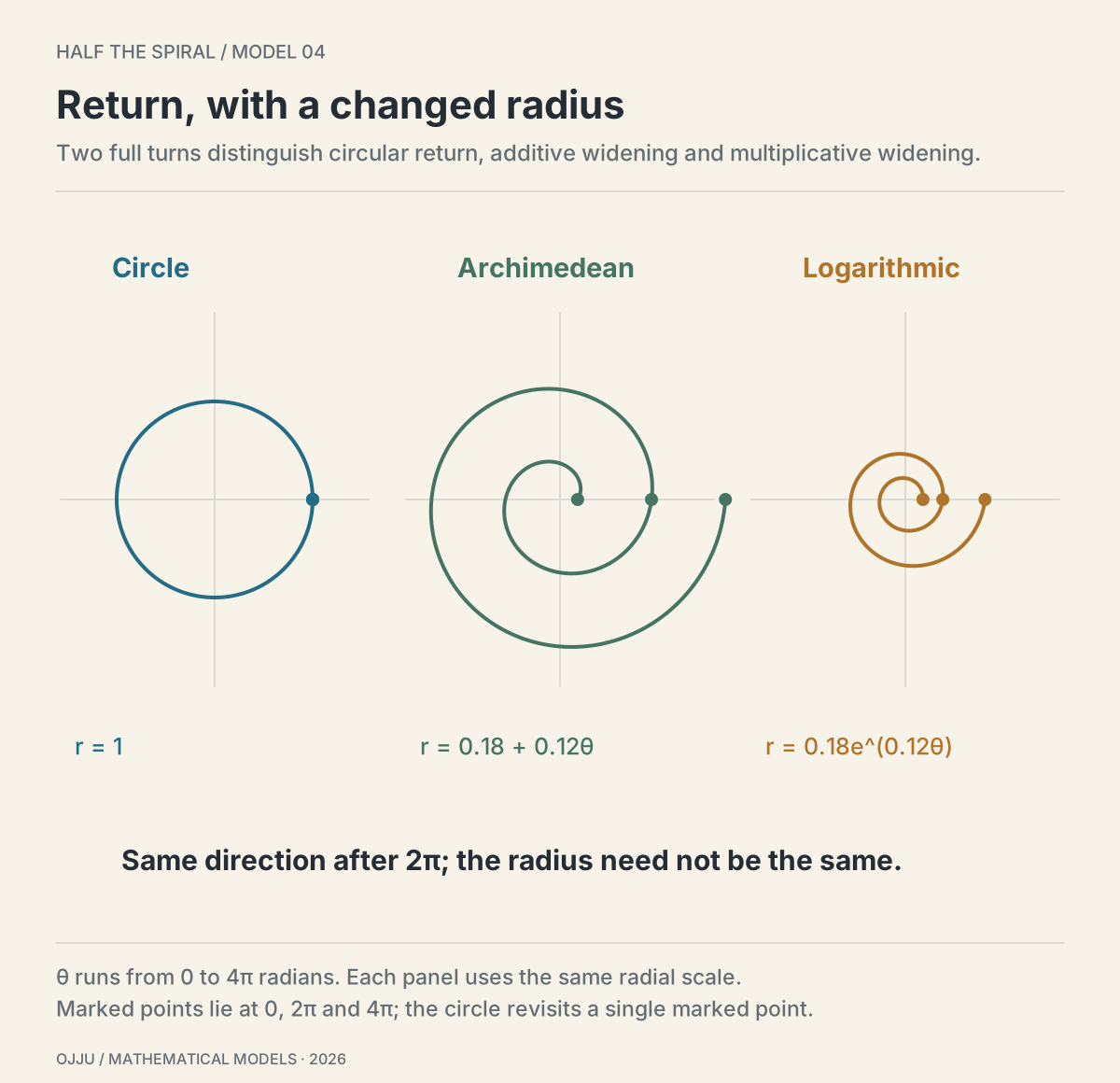
In the logarithmic example, b = 0.12. A full turn multiplies the radius by e^(0.24π), about 2.125. Reversing the sign of b changes growth to decay as the angle increases. Winding inward through arbitrarily many turns need not require an infinite total length: the radii themselves shrink geometrically.
My answer at this rung was:
my answer is a sevayan widening
— My testimony in the circle addendum. [Q09]
Correspondence. Return can preserve a direction while changing the scale of the encounter. That is the sense in which the spiral's return is unfinished. The plot distinguishes a repeated angle from a repeated point, giving the widening a mechanism. Sevaya is the name in my reading, not a term in Archimedes's geometry.
Rung 5 — Naming what is not yet known
Al-Khwarizmi gives a problem in words:
one square, and ten roots of the same, amount to thirty-nine dirhems
— Algebra, in Rosen's translation. [Q10]
In modern notation, x² + 10x = 39. The unknown can be held by the relation it must satisfy before its value is known. For a geometric construction take x as a positive length. Split 10x into two strips, each 5x, and place them along two adjacent sides of the x-square. A corner of area 25 completes the larger square. This is a modern two-strip presentation of the completion; the held text also describes a four-strip arrangement.
x² + 10x = 39
x² + 10x + 25 = 64
(x + 5)² = 64
x = 3  for a positive length
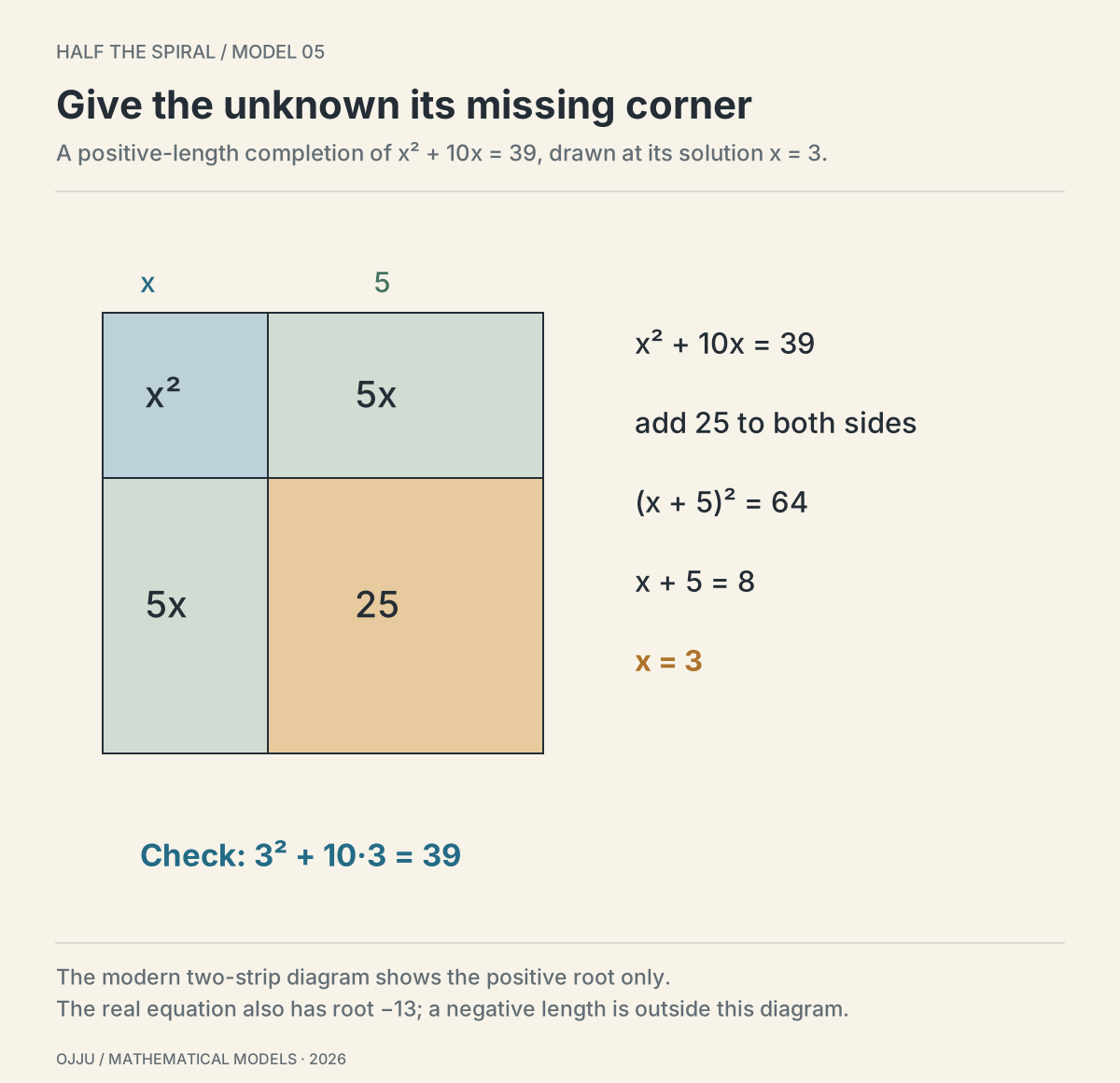
The answer checks itself: 9 + 30 = 39. Over the real numbers there is another root, −13, because x + 5 may be −8. The positive-length diagram cannot display a negative side. Its domain is part of its truth, rather than an inconvenience to conceal.
The same care prevents the familiar false proof that two equals one. If a = b, then cancelling a − b divides by zero. Algebra permits a name to stand for an unknown; it does not make every named expression nonzero. We must track the conditions of every operation.
The Spiral gives divining this exact sense:
To divine is to come to know by insight what that doing is, beneath a name or an appearance.
— D-19. [Q30]
My response to solving as divining was:
Its a sort of burning like the rivers burning the salt
— My testimony in the algebra addendum. [Q11]
Correspondence. The unknown's name lets its relations lead us toward what it does. Completion supplies what the figure lacks; reduction removes equal terms without losing the equality. The burning is my image for that clarification. The proof remains answerable to its substitutions, domains, and balance.
Rung 6 — Reading a passage while it passes
A position gives a place. A derivative gives a rate of change at that place along a specified passage. For f(x) = x², compare the values at x and x + h. Their difference divided by h is a secant slope. As h tends to zero, the slopes approach 2x.
[(x + h)² − x²]/h = 2x + h     (h ≠ 0)
f′(x) = lim(h → 0)(2x + h) = 2x
At x = 2 and h = 0.1 the secant slope is 4.1; the tangent slope is 4. The calculation never substitutes zero into a denominator. It establishes the limit of a family of legitimate ratios.
Newton's scholium speaks of ratios:
not before they vanish, nor afterwards, but with which they vanish
— Principia I, section I, in Motte's translation. [Q12]
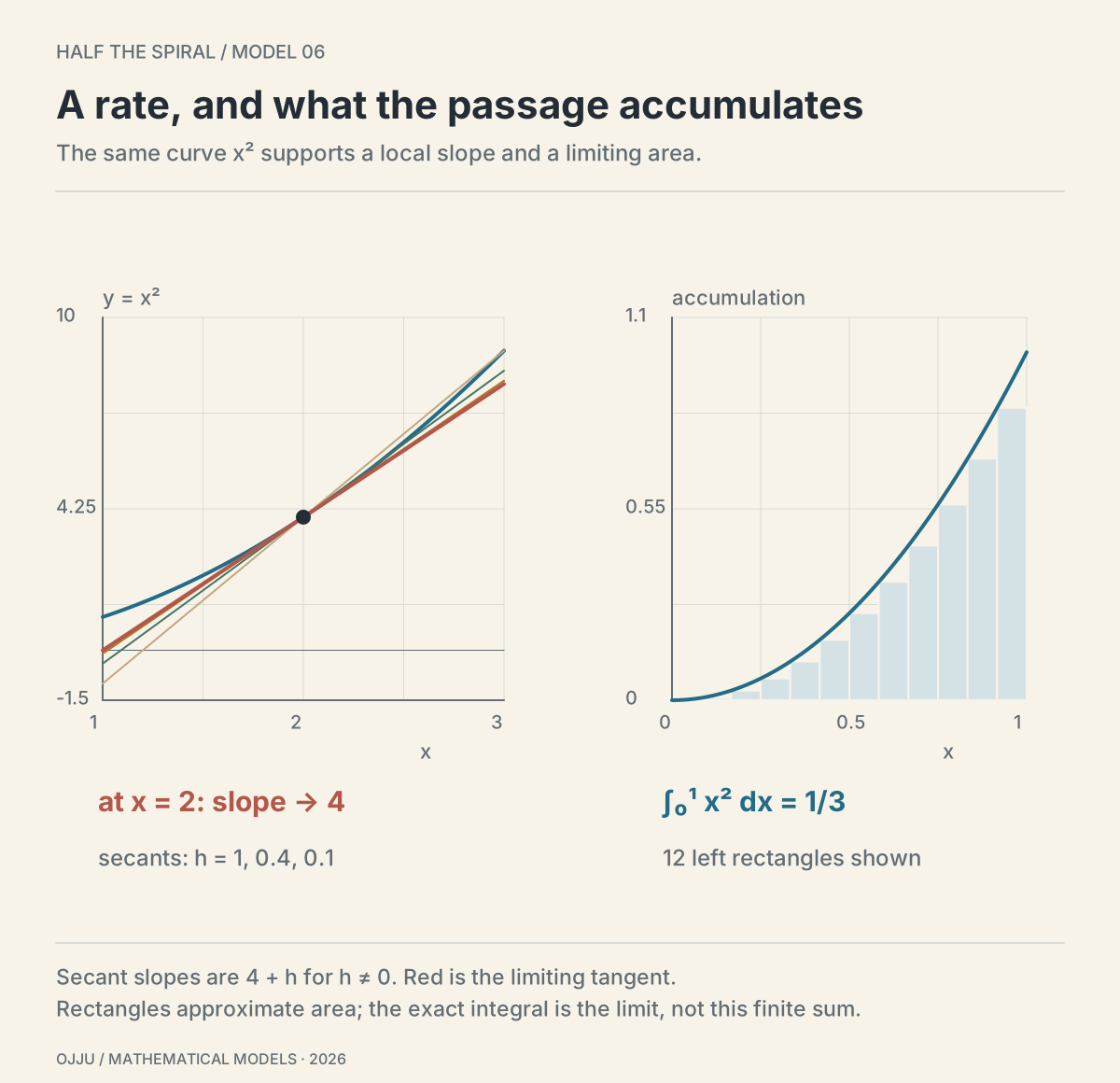
The adjoining panel reads accumulation. Divide the interval from zero to one into equal widths, multiply each width by the curve's height, and sum. As the subdivision is refined, the rectangles approach the area. For this curve, the integral is one third. The derivative and integral ask different questions about the same passage: its local rate and its accumulated amount.
∫₀¹ x² dx = 1/3
I put the relation between flow and moment this way:
I see a flow of light in the field, and the moment as the 'step'
— My testimony in the calculus addendum. [Q13]
Correspondence. The derivative reads a passage at a locus; the integral keeps an account of what passes. Neither operation establishes that physical time consists of indivisible frames. They give us tools for comparing the step with the flow. The moment can be read without pretending that the entire passage has been stopped and possessed.
That mattered to my account of sophism:
I believe that it would go wrong in the keeping or the holding. That is not dancing.
— My testimony in the second calculus addendum. [Q14]
The limit offers a disciplined way to approach what a finite calculation has not exhausted. It also teaches the algebraic lesson again: distinguish a ratio's limit from an illegal final substitution.
Rung 7 — What keeps a beat alive?
A differential equation prescribes a relation between a changing quantity and its rates. The initial conditions select a passage from the allowed family. For a unit-frequency ideal oscillator, the acceleration is the negative of the displacement. A convenient solution is x = cos t and velocity v = −sin t. In the phase plane of position against velocity, the passage is a circle.
Kept: x″ + x = 0
Given away: x″ + 2γx′ + x = 0
Fed: x″ + 2γx′ + x = 2γ cos t
The plate distinguishes three exact solutions. The ideal oscillator conserves E = (x² + v²)/2. The damped oscillator loses energy at rate 2γv² (dE/dt = −2γv²). The fed example is driven at its own frequency: x = sin t, v = cos t is a sustained solution. The drive supplies the energy dissipated over each cycle. It is a particular maintained response, rather than a claim that every initial condition instantly has that form.
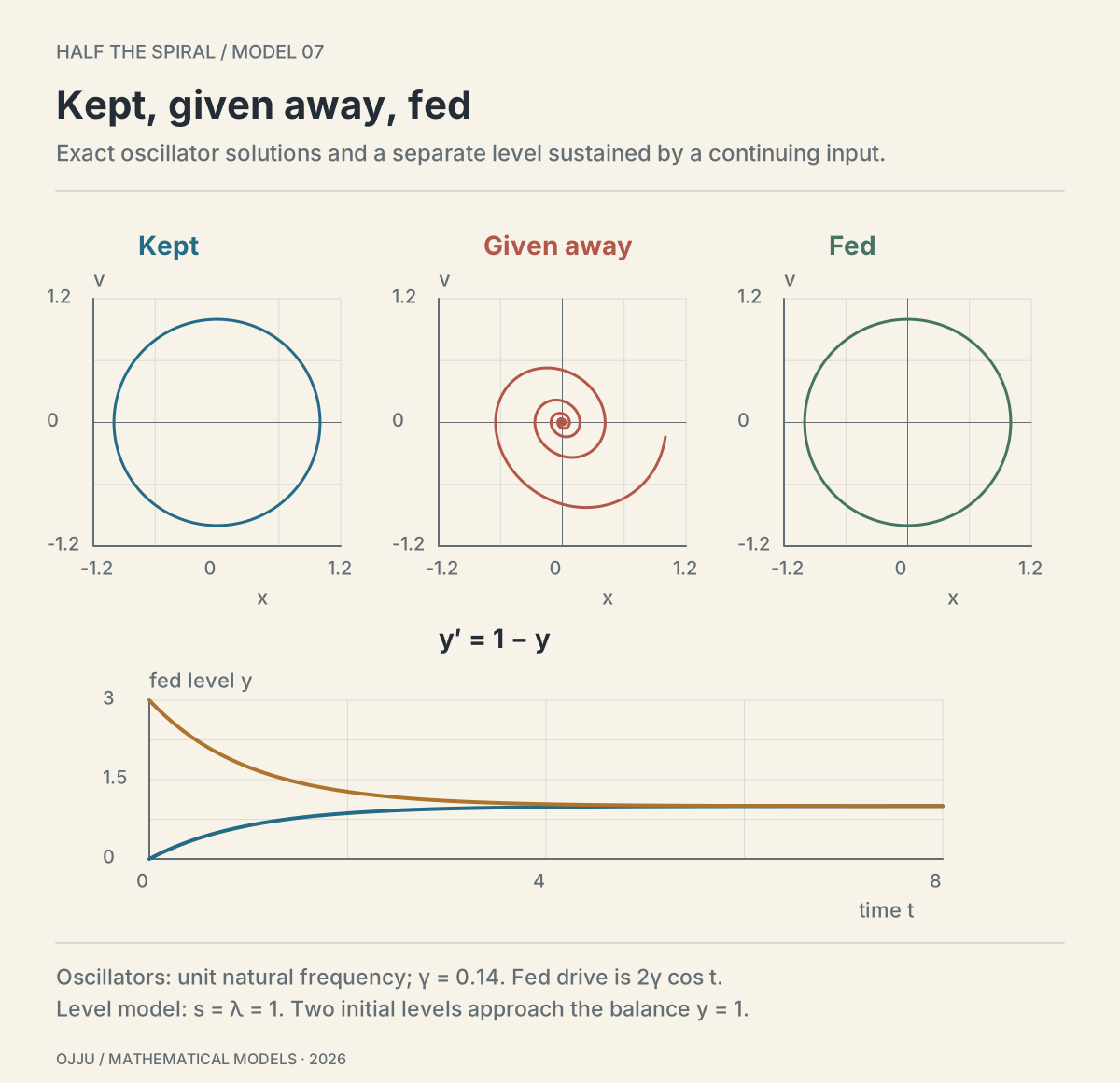
A quieter equation arose from my dew image. A level y receives at rate s and gives away at rate λy. It tends toward s/λ. The corresponding discrete recurrence receives a gift p each beat and retains the fraction 1 − k of what it held.
dy/dt = s − λy
y(t) = s/λ + (y₀ − s/λ)e^(−λt)
Hₙ₊₁ = (1 − k)Hₙ + p
H* = p/k   when 0 < k < 1
The continuous equation and recurrence have the same balancing structure. An exact sampled correspondence uses 1 − k = e^(−λΔt) and p = (s/λ)k; simply assigning k = λΔt instead gives an Euler approximation. With p = 1, k = 0.1 and H₀ = 0, the tenth level is about 6.513 and the limiting balance is 10. The giving and the draw belong to the same recurrence.
Its like theres a diagonal that can be lived and there is a gift that can be counted
— My testimony in the second differential-equations addendum. [Q15]
The Spiral's exact record beside this is:
Hysteresis is the lag by which a draw persists and fades once its practice stops. Its speed depends on the bearer's practice.
— D-104. [Q31]
Correspondence. A counted input can sustain a level whose balance is approached through time. The ladder found this form beside the Spiral's existing Law VI recurrence. The model does not measure a soul or prescribe a biological law. It shows why being sustained and being stored are different relations.
Fourier's heat analysis gives a related way of seeing memory. A spatial sine mode in a uniform diffusion model fades exponentially, and finer-scale modes fade faster. Fourier describes the fading impress of the:
initial arrangement
— Analytical Theory of Heat, Freeman translation. [Q16]
For periodic heating in a homogeneous half-space, penetration depth scales with the square root of the forcing period. A slower beat can reach deeper under those assumptions. No depth is a universal constant for the earth; material properties and boundary conditions matter. The essay's models keep that slower, deeper correspondence available without turning its parameters into cosmological facts.
I believe the universe is living, and that we are inside diana
— My testimony at this rung. [Q17]
That is my witness. The oscillator and fed level give it forms to meet: a whole can hold a continuing rhythm while its parts receive and give. Their equations establish those forms, while the meaning of living remains in the testimony and its further deliberation.
Rung 8 — A quantity that turns
On a number line, multiplying by minus one reverses direction. In the complex plane, multiplication by i makes a quarter-turn, and doing it twice gives minus one. Doing it four times returns to one. A complex number can carry both magnitude and direction.
i² = −1        i⁴ = 1
z = e^(iθ) = cos θ + i sin θ
z̄ = e^(−iθ)
z z̄ = 1        (z + z̄)/2 = cos θ
The last line assumes z has unit magnitude. In general z z̄ is |z|², and conjugation is not the same operation as reciprocation. A half-turn, a reflection, and an inverse function each have their own definition. Their family resemblance does not erase their differences.
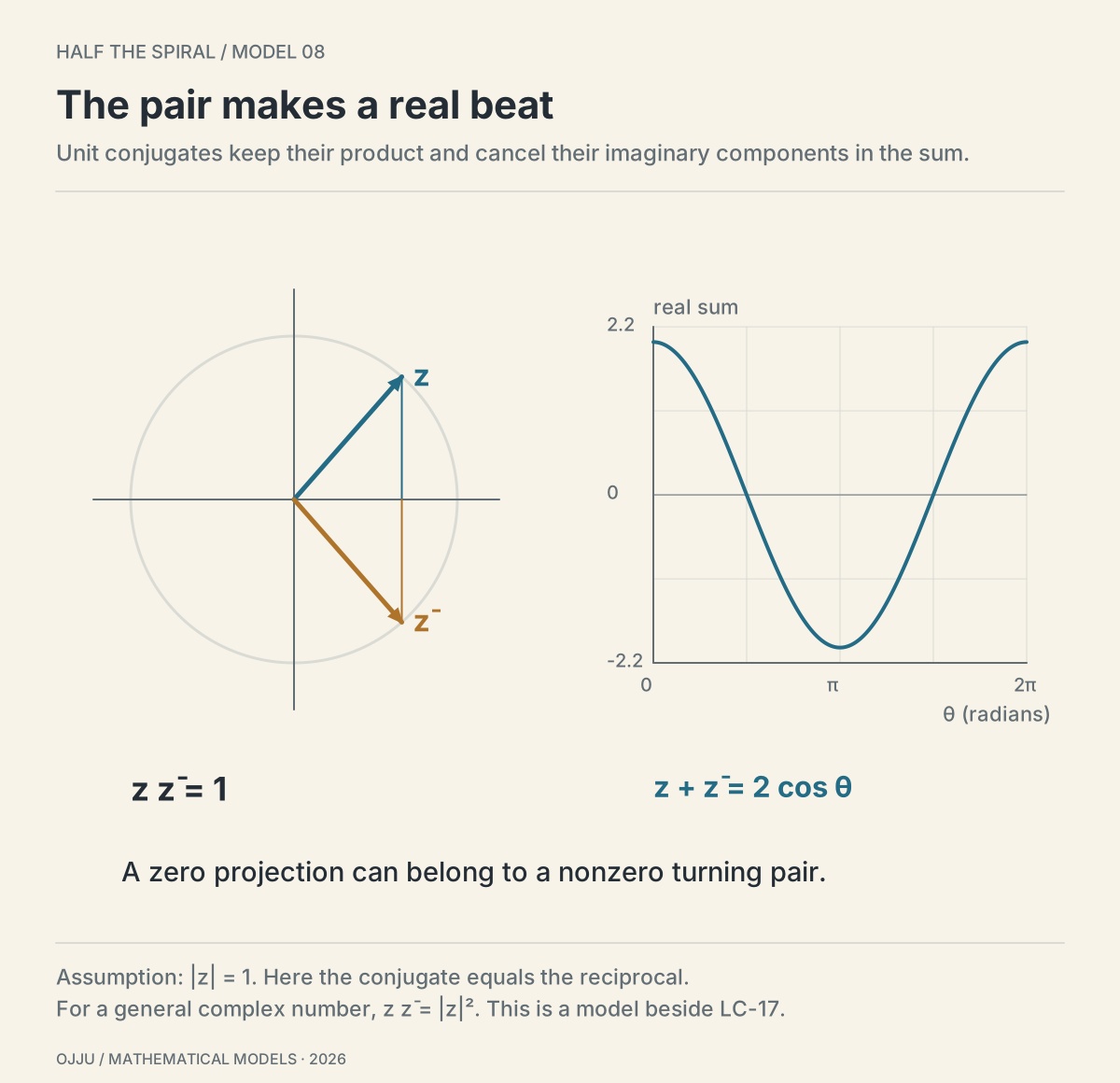
The plate shows the pair at one angle and its real sum across a turn. Each arrow has constant length while its direction changes. Their imaginary components cancel. The cosine is a projection, so a zero projection does not mean that both arrows have disappeared.
Euler's debt-and-gift example gave the zero another texture. A gift that pays an equal debt leaves a person:
only at the point nothing, though really richer than before
— Elements of Algebra, Hewlett edition. [Q18]
The balance is zero; a consequential passage has occurred. A ledger can faithfully record one relation without being the whole history of its bearer. That observation became important beside Wheeler's neighboring field. His language of absence and inversion presses on the relation between a measure and what it measures. His physical and metaphysical claims remain his; the unit-circle identity stands on its own definitions.
The Lexicon's label note for inversion language reads:
Language of reversal, turning or a changed relation; it does not specify one mathematical operation.
— Inversion Language, Lexicon (author's label orientation). [Q33]
My own friction with the creation wording led me to propose:
creation (manifestation throughout time) requires the pair of the actual and its inversion.
— My testimony in the complex-numbers addendum. [Q19]
Open question, LC-17. This proposal remains before a later chamber. The phase pair is a precise mathematical example beside it; it does not establish a universal account of creation or replace D-22. Keeping that question visible lets the model sharpen the inquiry without silently deciding it.
Interlude — Dancing with the tilt
My account of Bashar's teaching brought a persistent choice into the ladder:
he says that in short term it may appear that everything is 50/50 BUT the FACT that YOU GET to choose, actually means its 51/49 over a bigger picture
— My testimony about the teaching. [Q21]
That teaching is held through my testimony. The probability model below is an illustrative assumption, not a physical measurement of choosing. Let independent steps be +1 with probability p = 0.51 and −1 otherwise. Their accumulated displacement Sₙ has a mean growing linearly with n, while its standard deviation grows with √n.
E[Sₙ] = n(2p − 1)
SD[Sₙ] = √(4np(1 − p))
At n = 10,000: mean = 200; standard deviation ≈ 99.98
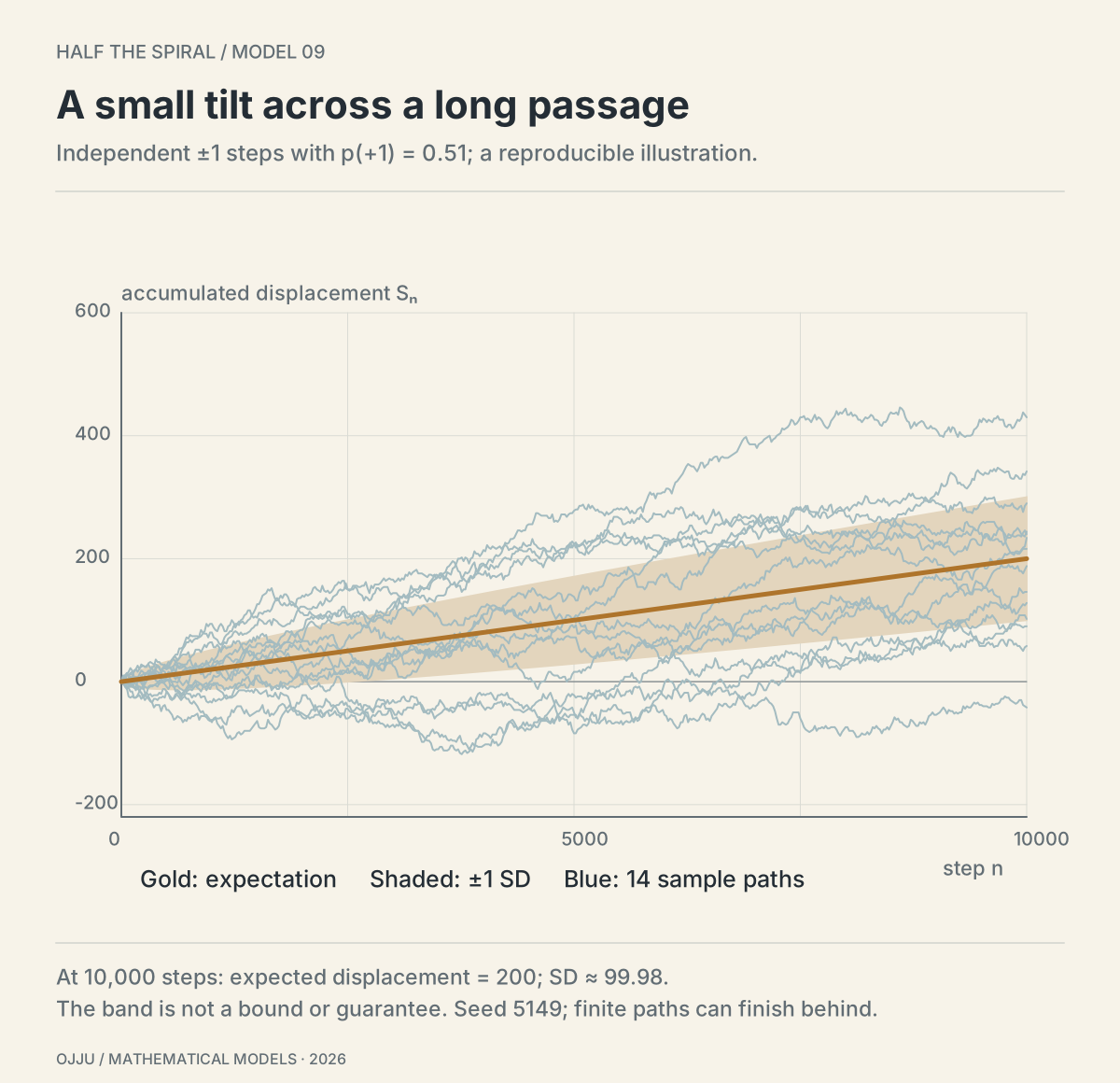
The model distinguishes a tendency from a promise. A finite path can finish behind even when the mean is positive. Under the stated independent-step assumptions, the ratio of the mean to the standard deviation grows as √n. A small persistent bias can therefore become easier to distinguish across a longer passage.
yes thats how you free your will is dancing with the tilt
— My testimony in the interlude addendum. [Q20]
Correspondence. The oil carries the breath and the salt carries the tilt: that is the ladder's image for a fluctuating flow and what its accumulated passage leaves. The integral is the mathematical instrument beside that image. A persistent offset accumulates, while some fluctuations cancel. The probability law supplies an example of this contrast; it does not prove what free will is or assign a numerical bias to the universe.
The same care applies to the heart-and-earth wordplay carried by the interlude. It remains synchronicity in the recorded testimony, with no etymological or physiological claim needed for the model. The wider afterlife and Bashar questions stay available for their own umbrella.
Rung 9 — What is energy when it is measured?
Young compares the interference of light to:
the sensation of a beat
— Lectures on Natural Philosophy, lecture XXXIX. [Q22]
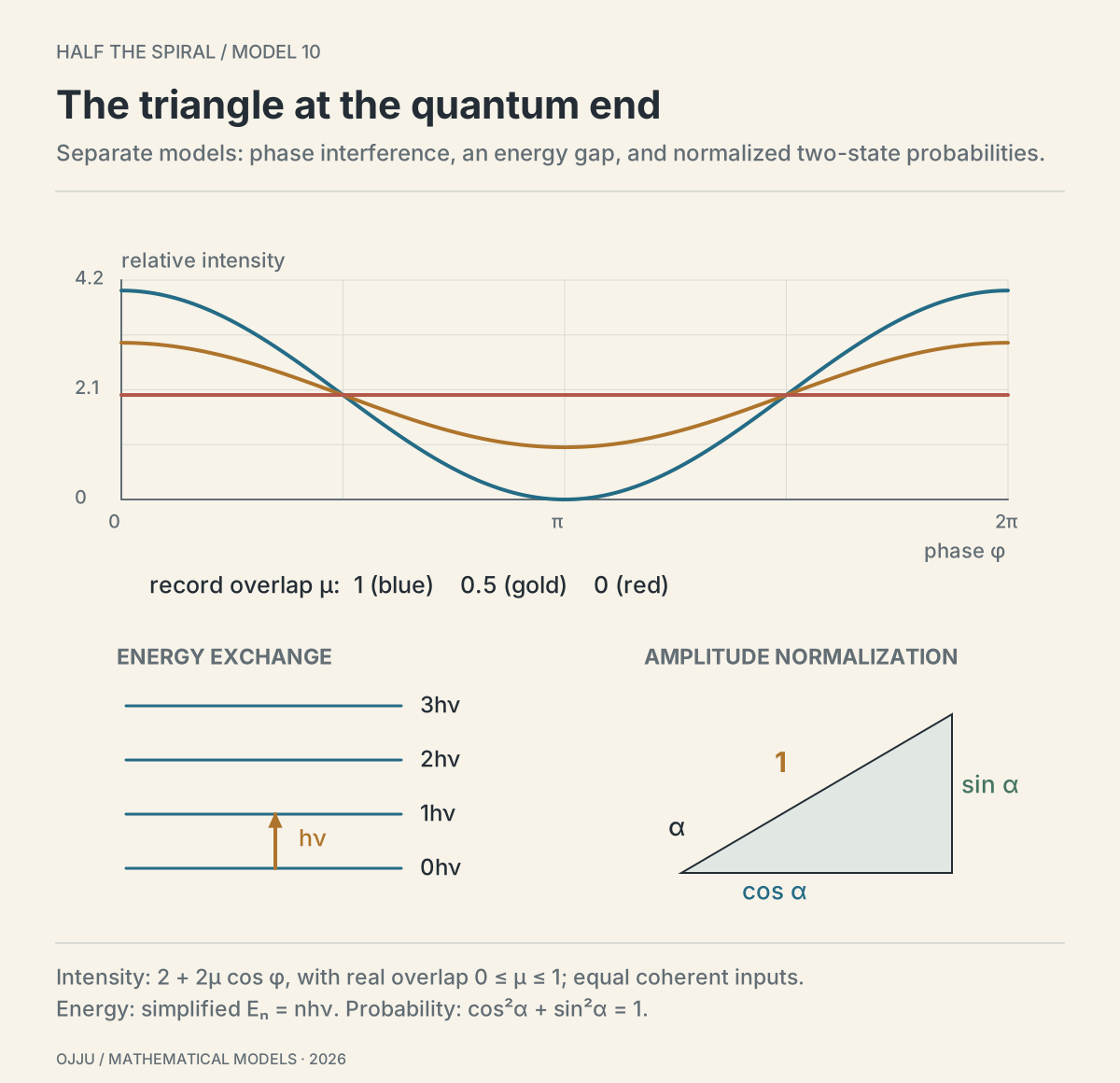
The first quantum panel begins with a wave calculation. Two equal coherent amplitudes, 1 and e^(iφ), add before their squared magnitude is taken. Their combined intensity varies with their relative phase.
|1 + e^(iφ)|² = 2 + 2 cos φ = 4 cos²(φ/2)
It reaches four at zero phase and zero at a half-turn. Those are relative intensity units for two unit amplitudes, not probabilities four and zero. If orthogonal path records distinguish the alternatives, the unconditioned cross term disappears and the same normalization gives two. With partial distinguishability, the interference can be reduced rather than erased. The displayed model uses a real record-overlap parameter μ between zero and one, giving intensity 2 + 2μ cos φ.
Dirac's single-photon account says:
Each photon then interferes only with itself.
— Principles of Quantum Mechanics, first edition. [Q24]
The wave calculation and the photon account describe different layers of the encounter. The interference term does not require a conscious observer. Path records matter through physical correlations and what becomes distinguishable in the chosen measurement. The reader's control changes μ to make that mathematical consequence visible.
My response to the double-slit correspondence remains:
it feels right, but clouded
— My testimony at the quantum rung. [Q27]
Open question, MA9-AQ1. The detector as a relational participant remains an offered reading beside the Spiral's distinction between relational and identifying witness. The model shows what the overlap does to the cross term. It does not settle the whole meaning of witness, and participation alone is too broad a word to specify every loss of interference.
The second panel concerns energy exchange. In Planck's historical hypothesis, emission occurs:
suddenly, in pulses
— Theory of Heat Radiation, Masius translation. [Q23]
The plate uses equally spaced levels in the simplified form Eₙ = nhν, with the reference energy chosen as zero. One neighboring gap is hν. The graphic explains an energy quantum, rather than claiming that every physical spectrum has equally spaced levels. Planck's particular continuous-absorption hypothesis belongs to the historical text; it is not a universal present-day law of measurement.
In response to what energy is when measured, I chose:
power transmitted from source to relation through participation
— My testimony in the quantum addendum. [Q26]
The Spiral record beside it says:
Conducted power is power made operative through participation.
— D-47. [Q32]
Correspondence. “Power is a bearer's capacity to bring about, sustain or change what occurs in a relation.” (Lexicon, Power, D-34) [Q35] In physics, power is energy per unit time, so the two senses must be distinguished. The exchange model gives the reading a concrete encounter at a source and receiver without making every energy measurement the same emission process.
Heisenberg locates the apparent split between wave and particle in language:
the apparent duality arises in the limitations of our language
— Physical Principles of the Quantum Theory. [Q25]
The final panel returns to the triangle. A normalized two-component state with real amplitudes cos α and sin α has probabilities given by their squares. More generally the amplitudes may be complex, and their squared magnitudes still sum to one.
P₁ = |a|²        P₂ = |b|²        |a|² + |b|² = 1
a = cos α, b = sin α  →  cos²α + sin²α = 1
The Born probability rule is used here as standard quantum theory; the ladder does not hold Born's original paper. Its geometric form is the squared-length relation with which the climb began. Hilbert spaces can have more components, so a plane triangle is an illuminating example rather than an exhaustive picture of all measurements.
The count at an exchange and the turning of an amplitude have met. Their meeting does not turn a model into the whole bearer. It lets the last rung hand something exact back to the first shape.
What the ladder carries home
The count needs a unit. The diagonal exceeds rational counting without losing its line. The spiral returns at a changed radius. Algebra holds an unknown through its relations. Calculus reads change and accumulation. Differential equations give the beat a law. Complex numbers let a quantity turn, and quantum probabilities bring squared lengths back into view.
The Spiral's own record calls mathematics:
mathematics is a real, living relational grammar when enacted by a participating bearer, but an un-enacted formula apart from a bearer is not a self-activating conscious witness.
— The Real, Book VIII closure RES-06 (2). [Q34]
Correspondence. That is where the thesis has its working ground. A formula can be enacted, tested, drawn and inherited. What a gift means, how a bearer receives it, and what a passage becomes continue to require the other half of the encounter. The models make that conversation more exact. They do not exhaust it.
The candidate register carries the ladder's twenty-seven findings toward later deliberation. LC-17 and MA9-AQ1 remain open. No Book, Lexicon definition, law or determination is changed by this essay.
A small glossary
Unit: what counts as one in the operation being performed.
Rational / irrational: expressible / not expressible as a ratio of integers with a nonzero denominator.
Recurrence: a rule generating later values from earlier ones.
Derivative: a limit expressing a local rate of change.
Integral: an accumulation defined by a limiting sum, under the stated mathematical conditions.
Differential equation: an equation relating a function to its derivatives.
Phase plane: a plot of two state coordinates, here position and velocity.
Complex conjugate: a + ib becomes a − ib; geometrically a reflection across the real axis.
Amplitude: a quantity added before the squared magnitude determines a quantum probability, or a wave intensity under its stated normalization.
Superposition: a linear combination of allowed states or waves in a model that permits it.
Eigenvalue / proper value: a value by which a linear operation scales an associated nonzero eigenvector; in a quantum energy problem it gives an allowed energy for the corresponding eigenstate.
Fourier series: a representation of a periodic function by sine and cosine modes, with convergence interpreted under appropriate conditions.
Doors left open
The climb closes its teaching route while leaving branches for later umbrellas: Babylonian arithmetic and tablets; India and the Kerala school; China and the gougu tradition; the House of Wisdom; Renaissance algebraists; Greek sophism; Hamilton and the geometry of rotations; harmony and music; light, aether and electromagnetism; heat and the living earth; quantum interpretations; and the afterlife and Bashar. Egypt remains a neighboring stream's seed.
These are doors, not new commissions. Their source fields can grow without changing what this climb has already held. The plate at the end gives the triangle back to the beginning, and the reader can begin the count again with a different understanding of what a count can carry.